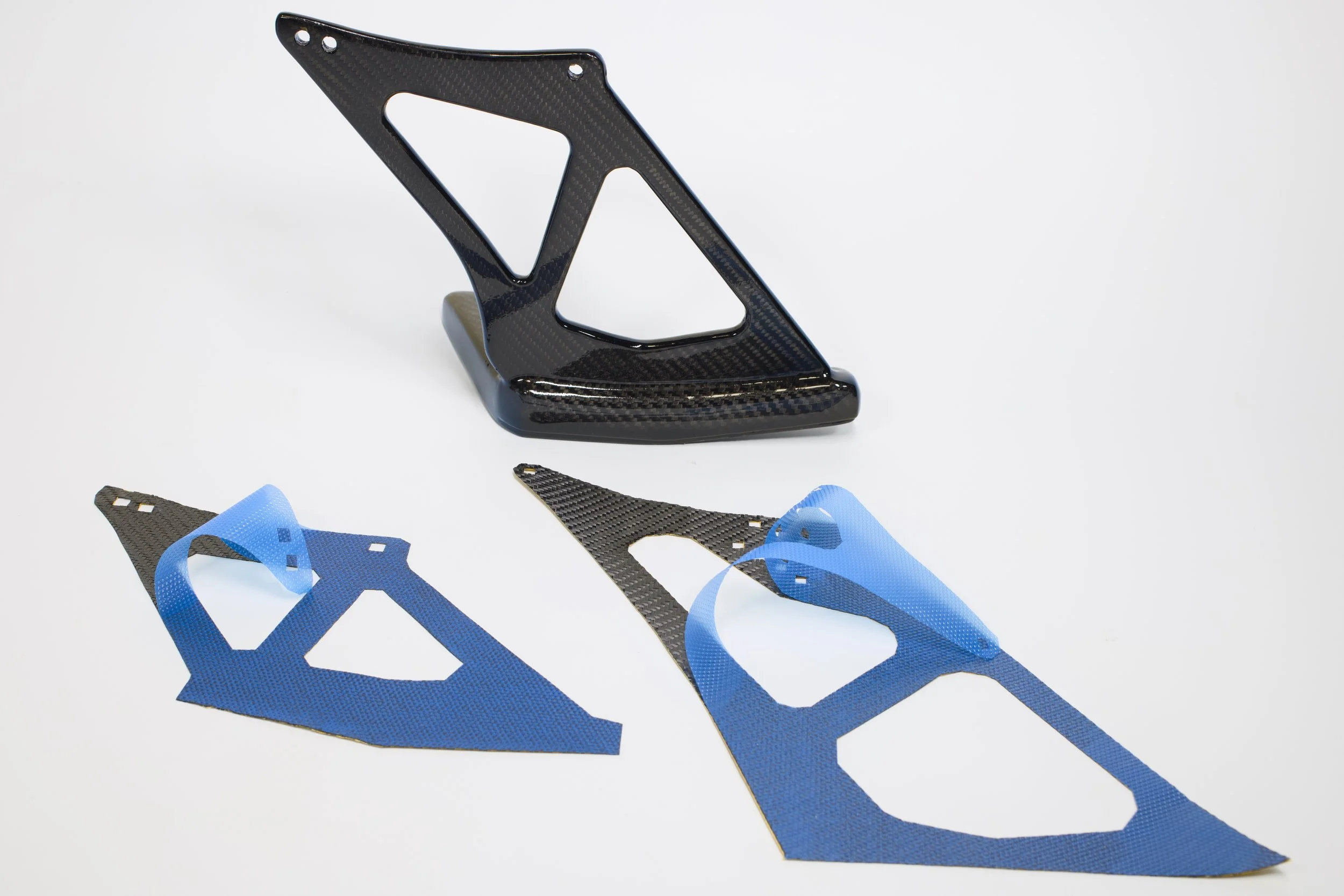
Over the past year, I’ve continued to push the development of my products with a focus on making them stronger, lighter, and more refined than ever before. Along this journey, the manufacturing process has evolved from traditional compression molding, to hybrid compression molding, and then to RTM (Resin Transfer Molding). Each step represented a meaningful improvement, whether through increased manufacturing efficiency, improved consistency, or a higher-quality finished product.
Today, that evolution reaches its next milestone: aerospace-grade prepreg carbon fiber.
Prepreg carbon fiber is the same class of material used in Formula 1 and other top-tier motorsports applications. Unlike traditional carbon fiber manufacturing methods, prepreg material arrives with a precisely controlled amount of thermoset resin already infused into the fabric—hence the name “prepreg.” This optimized resin-to-fiber ratio produces lighter, stronger, and more consistent components.
While my uprights were already exceptionally lightweight, one of the biggest advantages of prepreg construction is the improved surface finish. The molding process produces cleaner, more accurate parts that require significantly less post-processing. As a result, I can showcase more exposed carbon fiber than ever before. Earlier generations of uprights required a substantial amount of black airbrushing due to the characteristics of hybrid compression molding. With prepreg construction, little to no airbrushing is necessary. Parts can be painted faster, and more of the carbon fiber weave remains visible throughout more of the finished product.
Prepreg carbon fiber also delivers two additional benefits: increased heat resistance and greater structural strength.
Heat resistance has increased from approximately 180°F to 250°F. While 180°F is more than adequate for most exterior automotive applications, the increased thermal capability provides greater flexibility for future products designed for higher-temperature environments.
Strength has also been improved. While the existing uprights have proven themselves in both street and racing environments, additional strength is always welcome. I firmly believe that over-engineering critical components is never a bad thing—especially when supporting aerodynamic loads generated by wings capable of producing hundreds of pounds of downforce. The factory GT500 Carbon Fiber Track Pack wing, for example, can generate approximately 550 pounds of downforce at speed.
These new prepreg components will be offered under the Carbon Prepreg Series banner. Existing uprights will transition into this series, and future products—including the AC Ducts and AeroShark—will be produced using the same advanced manufacturing technology.
At BTI, the goal has always been continuous improvement. The transition to prepreg carbon fiber represents another step in the ongoing pursuit of building the best possible products, using the best possible materials and manufacturing methods available.
Prepreg carbon fiber